Prevention as a practice
The case for regularly doing deeper

Years ago, I was sitting in the hallway of yoga studio in the middle of Bedstuy, Brooklyn, surrounded by a bunch of other sweaty bodies with whom I'd just completed an intense hot vinyasa class. I was a few years into my yoga journey, and this studio was new to me, but it was quickly becoming my second home. The teachers, the students, the whole space was a balm for the rawness of reality, and I felt like I’d found one of the only truly safe spaces that existed in the city.
As I was tying on my sneakers, I overheard a conversation between the teacher and another student. The student mentioned it was the first yoga class she’d ever taken.
The teacher responded sharing the usual things about after-class care, like ”Be sure to drink lots of water because you just sweat out a bunch of fluids.” and ”Your body will be super sore - that's to be expected.”
But then he said something that really caught my ear. He said, “Try to come back every day. Come to class when you want to, but also when you don't want to. In time, it'll become a lot easier.”
This sage advice was small, a mere two seconds of advice that could easily have been brushed off. But it packed a punch in it's resonance and the truth it carried, not just for a yoga practice, but for virtually any work that we attempt to do.
Why I love the term “stretching your edges”
The things that have really made a difference in my life aren’t the things I stopped doing just because they got hard. Yoga is the obvious example to follow the story above, but I could also say that writing is another. And therapy is another. Cooking is another. Running is another. Reading, learning, money-management, couple's counseling, conflict resolution, family bonding, building and running a business…all of these things were very hard, and the work I put into doing them came back to me as endless value and fulfillment.
We all know the edge of our limitation lives at the place where we start to feel discomfort. We all know that growth comes with pushing up against that edge.
What we don't always know is how to get to that edge. But what my teacher said years ago to that other student offers us a clue.
The difference between prevention and prescription
Take a moment to think about something that you do pretty regularly. Something that doesn't require a lot of brain power - like making your morning coffee, or going for your afternoon walk.
Now take a moment to think about what that practice gives back to you. If it's coffee, perhaps its the boost of energy you need before work. If it's a walk, maybe it's a shift in your perspective and mental clarity in the middle of your day. Identify how this simple activity, that requires virtually no effort, supports you.
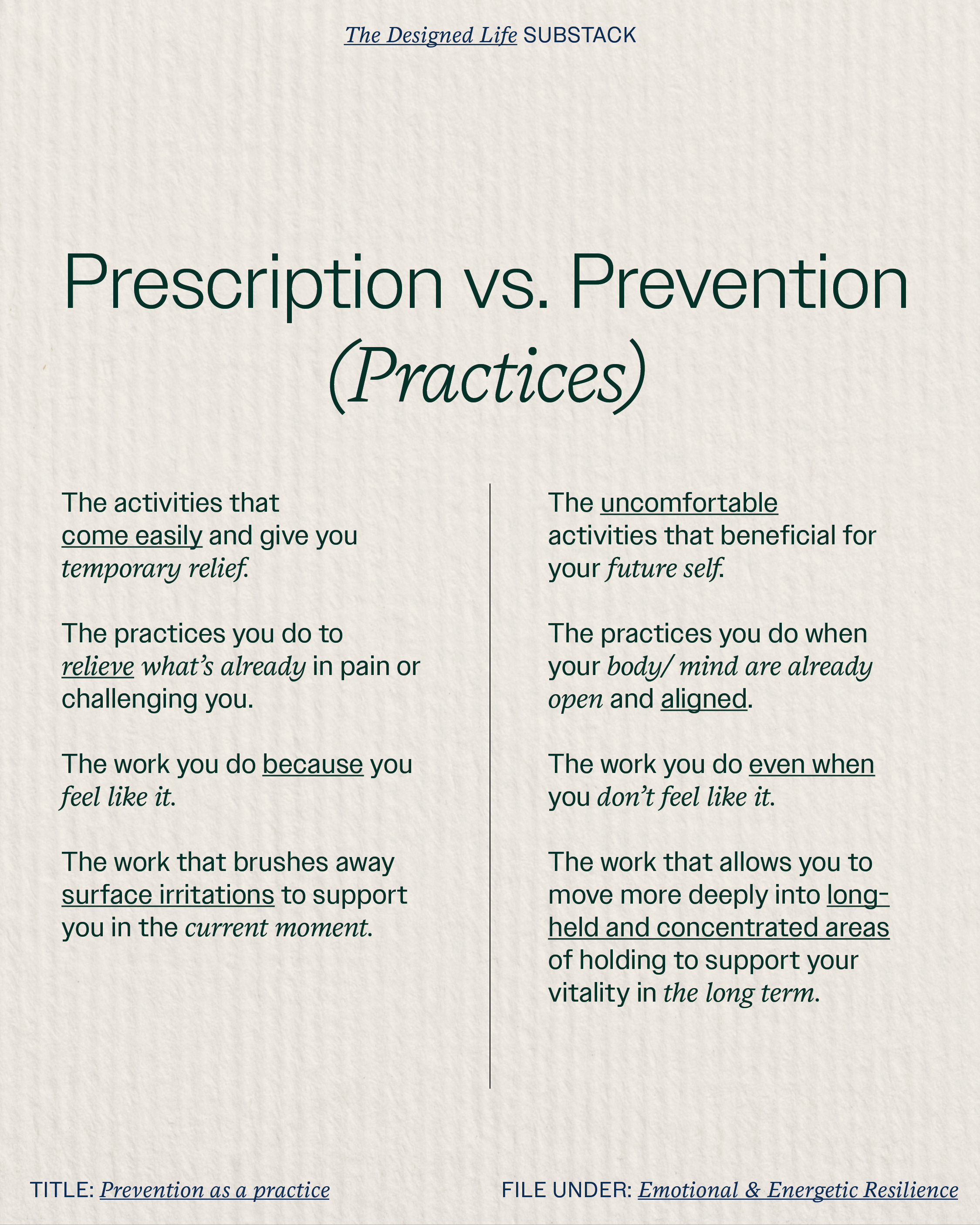
Consider this your prescription. It's the activity that helps you alleviate surface discomfort (like morning grogginess or afternoon mental sluggishness) and clears away the dust.
I like to think another example of prescriptive behavior as going to a massage therapist because your body is achy. Or starting to eat more plant based because your doctor told you you needed to watch your cholesterol.
You get what I'm saying?
If that fresh new yoga student in my class years ago had started going to yoga just because she felt like it - that would have also been using yoga as a prescription. To an extent they would be staying in their comfort zone, because their reason to show up on the mat would be because they had the urge (whether physical or intuitive), which usually correlates to doing something that fits within your known boundaries.
If instead they chose to start going to class even when they didn't feel like it, when they knew that it would be what their body needed but mentally or even energetically they fought the idea - then they would be using yoga as prevention.
Prevention is doing the work when either 1) your body and mind are already open and aligned (so a prescription isn’t needed), or 2) when something feels just outside your zone of comfort to the point where it feels a little uncomfortable to do.
If you’re in option 1, and you’re in a place where you don’t need the work right now, prevention work is helpful because you have the ability to move a few layers deeper into long-held, more concentrated areas of holding that you wouldn’t normally be able to get to if you were doing the surface layer dusting.
If you’re in option 2, and the work feels uncomfortable but on a certain level you know it would be beneficial - that’s when you’re pushing up against an edge, and the growth you want is on the other side.
The power of prevention
Prevention is looking at your morning coffee, asking yourself why you rely on it so much, and looking at the underlying reason you're so groggy in the morning – and then (most importantly) shifting your behavior accordingly.
Perhaps you discover that your morning fog stems from frequently staying up late scrolling. So you start to leave your phone in another room at night.
Maybe you find that your sleepiness comes from the restless tossing and turning you often experience because you tend to snack really late at night and snacking disturbs your ability to fully rest (this is me calling out my partner). So you start having calming tea before bed to satisfy your oral cravings.
Or maybe you discover you're super tired every day because your life is actually full of stress and you're not doing anything to alleviate or manage it. So you start seeing a therapist and meditating a few times a week.
Prevention is doing the work of going deeper - of not just wiping the dust from the surface, but actually scrubbing into the grooves and corners we overlook.
It's asking why, and then asking why again.
And then maybe asking why one more time.
So why is this important?
You might be thinking, sure, I could investigate a bit more into why I do the things I do, but my life is fine – what's the point of disrupting it?
Prevention is not for you in the present - it's for you in the future.
I'm assuming if you're here reading this that you have goals for yourself. You have visions of things you want to create and build and achieve. You have aspirations and ambitions and a life that you desperately want to be living right now.
Well, the difference between who you are now and that person you want to be in the future is not something you're going to find in a self-help book or by following someone's 8-step plan to achieve xyz.
The gap between who you are now and the future self you want to become will close the more you do your unique prevention work.
If you stay in the same routines, you can expect the same results. But if you start to examine what lies under the surface of the routines that merely offer you a salve, then you'll find the exact blockages, obstacles and narratives that keep you from stitching up the and healing the whole wound.
You will find the real reasons why you do the things you do, and with that information you can start to use and apply your energy more effectively.
Let's go back to the yoga example. If I were to go to a yoga class once a week or when I felt like it (prescription), I would like leave class feeling refreshed and like I did something good for myself, but that lower back pain or that tension in my shoulders, or the general frustration I have with my life would probably still linger.
But if I were to go to yoga several times a week, even when my inner child was screaming that they just wanted to veg out in front of the tv instead (prevention), I would not only leave each class feeling stronger and more energized over time, but I would likely start to alleviate my physical aches and pains, expand my flexibility, deepen my ability to focus, and experience more mental clarity that helps me to make little adjustments to my daily life that create more fulfillment.
Now, I feel the need to clarify here that I'm not trying to tell you that you need to go to yoga every day or give up your morning coffee. Not at all.
But what I am saying is that when you do the work to pull back just one more layer - when you show up for your practice even when you don't feel like it, or when you examine the reason behind why you do things, or when you let yourself get curious about your reactions or patterns or beliefs - when you keep stretching even when it feels itchy, scratchy, uncomfortable or just not fun – that's when the breakthroughs happen.
And the only way to get there is to follow your own discomfort.
From my vantage point I can't look at you and tell you where you get uncomfortable – only you know that. So let me ask you, what is the thing in your life that you're not looking at? What are the habits that act as salves for bigger wounds? What are the practices that you only do when you feel like it?
Can you go a little deeper into why?
Prevention work gives you your energy back
You could say that the way I'm using the word prevention here is just another way of describing consistency. And yeah - that's partially true.
But I would also say that prevention in this context is specifically for the purpose of relieving the invisible energetic blockages that hold us back from stepping into the next level we so crave for ourselves.
In a sense it's consistency with the added layer of intention. Where consistency evokes a feeling of hard work, your specific “prevention work” will free up and give you energy.
How?
You will spend significantly less time, energy and resources trying to regulate.
So much of our lives are spent regulating - because we don't look at the underlying causes of our patterns and behaviors, and we only do the work when it feels comfortable. So we stay in loops of maintenance.
Alternatively, if we look at the reasons why we do things, and we get a little outside our comfort zones, we can start to address the real reasons that cause us to operate the way we do now.
Rather than continuing to put bandaid on the wounds, we can stitch them up and our skin can start to knit back together. We can start to plug up the leaks of our energy. We do the deep cleaning to remove the stuff that's clogging up our ability to move freely.
Prevention is the work that unravels the underlying problems that keep us from staying regulated. When you go deeper, you make real, effective change because you're doing regular cleaning.
You can think of it as the difference between monthly vacuuming and tossing of all your garbage versus vacuuming and throwing out the garbage once a week. The latter makes it so that every week is there's less of a load to carry and less to clean, and your home feels cleaner more consistently.
Doesn’t that sound easier?
Integration
I am not about to leave you here without some tools for how to integrate this information (if you so choose).
If you’re in a place where you feel stuck, dissatisfied, overly comfortable to the point where it feels irritating, or like you’re ready to break into your next level – here’s some things to consider:
Examine your routines of comfort. Why do they exist? What is the underlying motivation of these routines? What value do they bring you? Is there a layer under your reasoning for these routines that you’re avoiding? Is there a way to get the value of these routines by tending to that deeper reasoning?
Ask yourself what you’re not looking at. What are you avoiding? These questions might not be as easy to answer because some things that we don’t look at are actually just outside of our peripheral vision and impossible for us to see right now. But I encourage you to let these questions sift into your mind - ask them of yourself often, and be curious and open to whatever arises.
Consider the goals and ambitions you have set for yourself. To what extent do you believe you’re capable of achieving these goals? What is the boundary of your belief? That is the edge you need to push up against - how can you prove to yourself that you can stretch beyond this edge?
If you need extra support, connect with me for holistic life-coaching so I can help you navigate these deeper layers. Additionally, check out this post I wrote about how to stretch your edges for further support.
If there’s anything I’d love for you to take away from this read is that sometimes the growth, the lightness, the solutions, the transformation your looking for is on the other side of doing the things even when you don’t feel like it. Keep doing the practices that you know are leading you in the direction of what you most want, especially when they’re hard.